| MAIN MENU |
| Home |
| Current Issue |
| Archives |
| ABOUT THE JOURNAL |
| About the Journal |
| Focus and Scope |
| Editorial Team |
| Contact |
| POLICIES |
| Open Access Policy |
| Copyright Notice |
| Plagiarism Policy |
| Publication Ethics |
| Privacy Statement |
| Advertising and Marketing Policy |
| Revenue Sources |
| AUTHORS |
| Submissions |
| Author Fees |
| Peer Review Process |
| OUR COMMITMENT |
Double-blind peer review. Immediate open access. Authors retain copyright. Published twice a year. |
Vol. 1 No. 1 (2026): June 2026
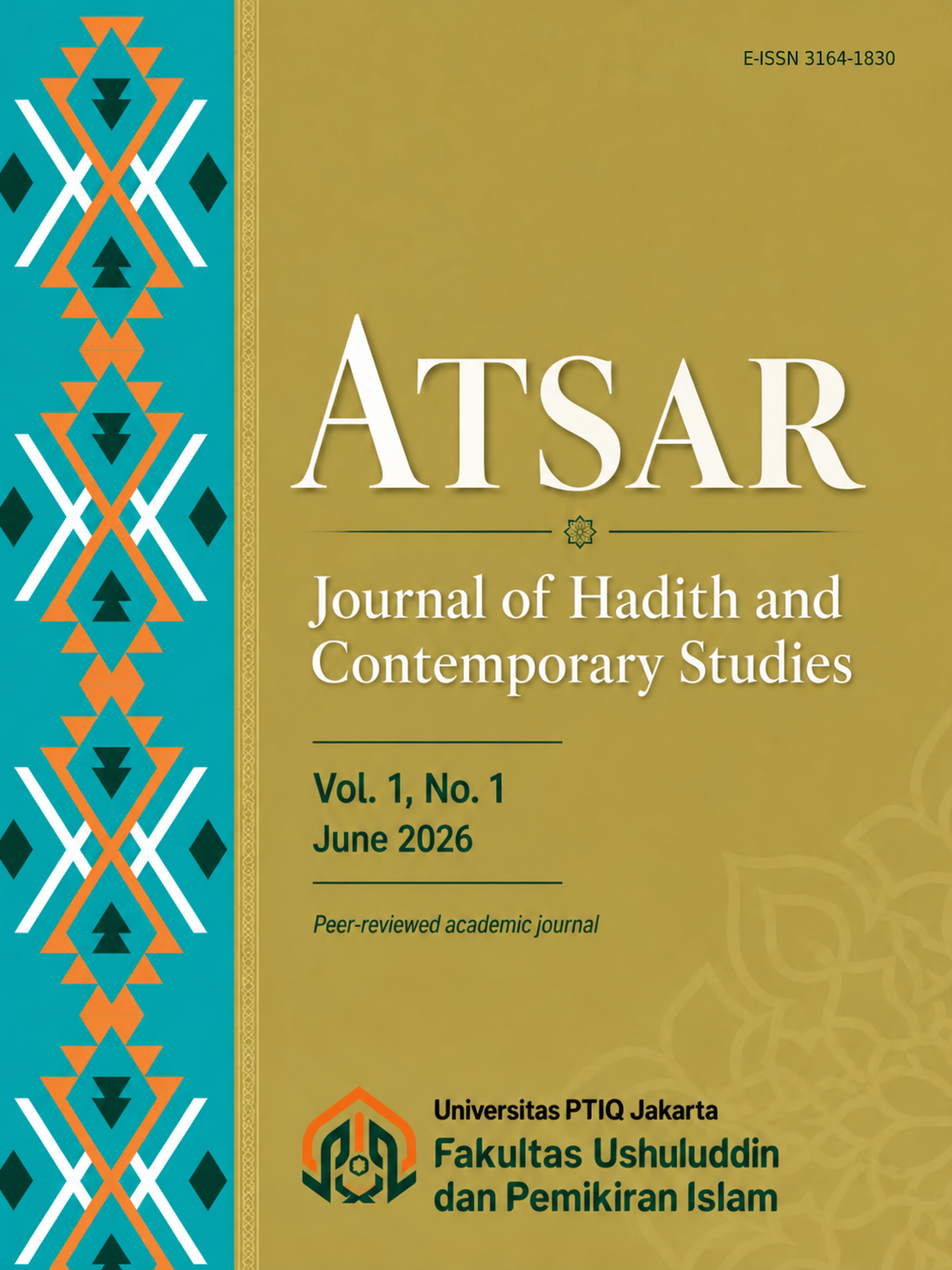
This inaugural issue of Atsar: Journal of Hadith and Contemporary Studies publishes nine articles that reflect the breadth of contemporary hadith scholarship. The issue examines prophetic values as spiritual coping and mental resilience for Muslim Generation Z in the digital age; the contextual meaning of sunnah between normative prescription and the living practice of the Prophet; women’s exclusion from digital religious production and patriarchal readings of hadith on Islamic platforms; a source-critical and thematic reconstruction of shūrā in the Nine Canonical Ḥadīth Collections; genealogical approaches to Living Hadith through field takhrīj and social transmission; the integration of sociological agency theory into Living Hadith methodology; the mapping of contemporary hadith studies beyond the riwāyah–dirāyah bifurcation; maqāṣid-based recontextualization of hadiths on war, apostasy, and espionage; and computational linguistic analysis of al-Mawqiẓah in ḥadīth terminology. Collectively, these articles demonstrate the expanding scope of hadith studies in addressing methodological, textual, social, digital, gender, psychological, political, and computational challenges in contemporary Muslim life.
Published:
2026-09-01


