| JOURNAL IDENITITY |
| ISSN (Print): 2338-4131 |
| ISSN (Online): 2715-4793 |
| DOI: doi.org/10.56872/elathfal |

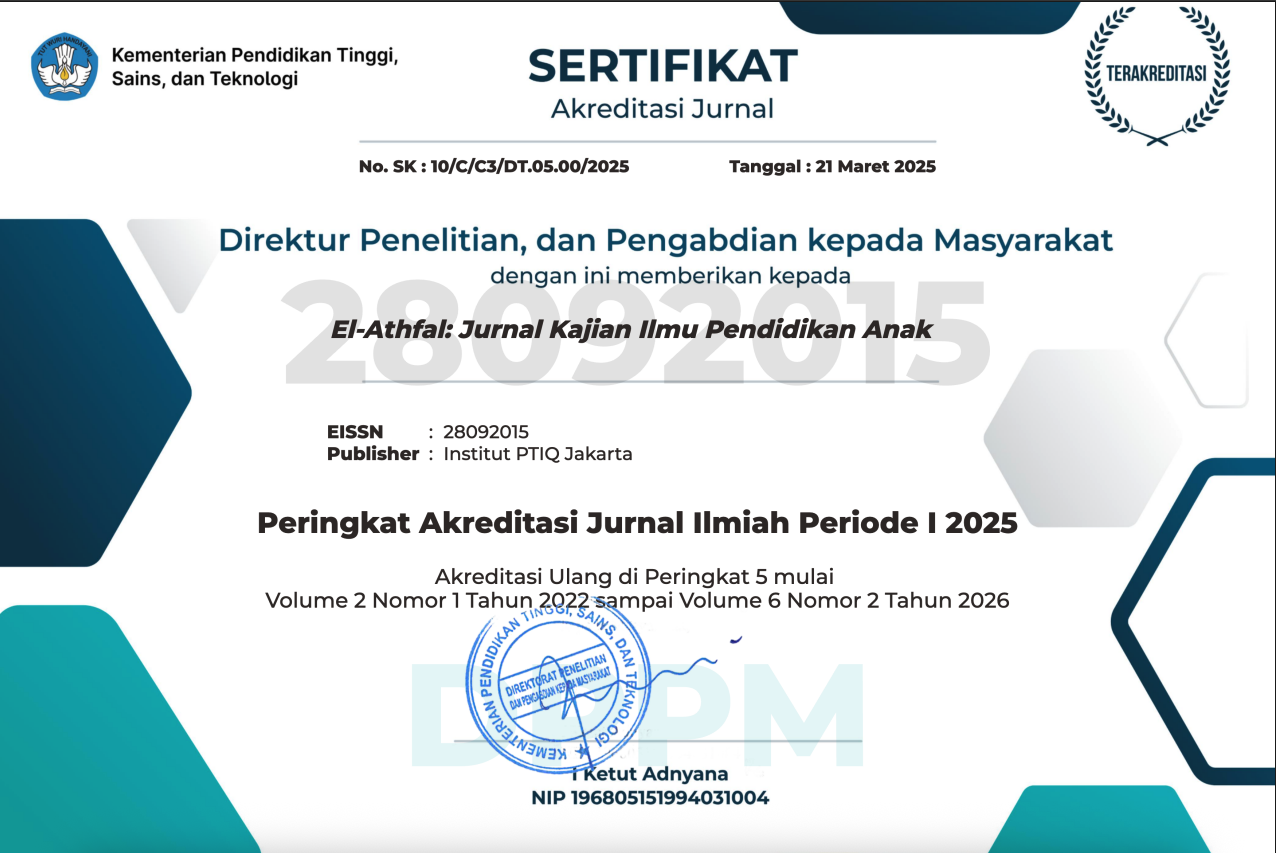
El-Athfal: Jurnal Kajian Ilmu Pendidikan Anak applies a peer-review process to ensure the quality, originality, academic rigor, and relevance of manuscripts submitted for publication. The journal is committed to conducting the review process fairly, objectively, confidentially, and transparently, in accordance with established principles of publication ethics.
All manuscripts are evaluated based on their scholarly merit, relevance to the journal's focus and scope, methodological appropriateness, originality, clarity of presentation, and contribution to the field of child education, particularly Early Childhood Education.
All submitted manuscripts undergo an initial screening by the editorial team to determine whether they meet the journal's basic requirements.
The initial screening considers the following aspects:
Relevance to the journal's focus and scope.
Compliance with the Author Guidelines and manuscript formatting requirements.
Originality and preliminary plagiarism screening results.
Clarity of the research objectives and scholarly contribution.
Appropriateness of the research design and methodology.
Completeness of the manuscript and required submission information.
Compliance with applicable research ethics and publication policies.
Manuscripts that do not meet the journal's basic requirements may be returned to the authors for technical revision or rejected without external peer review. Manuscripts that pass the initial screening may proceed to the peer-review stage.
The journal employs a double-anonymous peer-review process, in which the identities of authors and reviewers are concealed from each other during the review process.
Authors must ensure that the main manuscript does not contain identifying information, including author names, institutional affiliations, acknowledgments, or other details that could compromise reviewer anonymity.
Reviewers are expected to assess manuscripts objectively and independently, without bias related to the authors' identity, institutional affiliation, nationality, gender, religion, or other personal characteristics.
The editorial team is responsible for maintaining the confidentiality and integrity of the review process.
Manuscripts that pass the initial editorial screening are assigned to qualified reviewers whose expertise aligns with the subject matter and methodology of the submission.
Reviewers are selected based on their academic qualifications, relevant research experience, subject expertise, and ability to provide constructive and impartial evaluations.
The journal seeks to avoid conflicts of interest when appointing reviewers. Individuals with financial, professional, personal, institutional, or other relationships that could compromise their impartiality should not review the manuscript.
The editor may appoint additional reviewers when necessary to obtain sufficient expertise or resolve substantially differing recommendations.
Reviewers are asked to evaluate manuscripts according to the following criteria, as applicable to the manuscript type:
Relevance and Scope: The extent to which the manuscript aligns with the journal's focus and scope.
Originality and Contribution: The novelty, significance, and contribution of the manuscript to existing knowledge or educational practice.
Literature Review: The relevance, adequacy, and critical use of previous research and theoretical perspectives.
Research Methodology: The appropriateness, rigor, and transparency of the research design, data collection, and analytical procedures.
Results and Discussion: The clarity, accuracy, and depth of the findings and their interpretation.
Ethical Compliance: The adequacy of research ethics safeguards, particularly for studies involving children and other human participants.
Writing and Organization: The clarity, coherence, structure, and academic quality of the manuscript.
References and Citations: The accuracy, relevance, and consistency of citations and bibliographic information.
Conclusion and Implications: The extent to which the conclusions are supported by the findings and provide meaningful implications for research, policy, or educational practice.
For conceptual, theoretical, and literature review articles, reviewers may apply criteria appropriate to the manuscript's purpose and analytical approach.
After evaluating a manuscript, reviewers provide comments and recommendations to the editor. Possible recommendations include:
Accept: The manuscript is suitable for publication without substantial further revision.
Minor Revision: The manuscript requires limited revisions that do not substantially alter its overall contribution.
Major Revision: The manuscript requires substantial improvements in its theoretical framework, methodology, analysis, discussion, or presentation.
Reject: The manuscript does not meet the journal's standards or is unsuitable for publication.
Reviewer recommendations are advisory. The final decision rests with the editor, who considers the reviewers' reports, the manuscript's quality, the journal's editorial standards, and any relevant ethical concerns.
When revisions are requested, authors must revise their manuscripts in accordance with the reviewers' comments and editorial instructions.
Authors should submit:
A revised version of the manuscript with changes clearly indicated, where requested.
A point-by-point response addressing each reviewer comment.
A clear explanation and academic justification for any recommendation that the authors do not adopt.
Revised manuscripts may be returned to the original reviewers for further evaluation, particularly when major revisions have been requested. The editor may also assess the revisions directly when appropriate.
Failure to submit revisions within the specified period, without an approved extension, may result in the manuscript being closed or treated as withdrawn.
The journal aims to process manuscripts as efficiently as possible while maintaining the quality and integrity of peer review.
The duration of the review process may vary depending on reviewer availability, manuscript complexity, the need for additional reviews, and the extent of revisions required.
The editorial team will communicate significant developments and decisions to the corresponding author through the journal's online submission system or official editorial correspondence.
Any estimated review timeline published by the journal should be understood as a general target rather than a guarantee.
Reviewers must treat all manuscripts and associated materials as confidential documents. They must not disclose, reproduce, distribute, or use unpublished information from a manuscript for personal, professional, or research purposes without appropriate authorization.
Reviewers are expected to:
Provide objective, evidence-based, and constructive feedback.
Identify relevant published work that has not been appropriately cited.
Report potential plagiarism,
| JOURNAL IDENITITY |
| ISSN (Print): 2338-4131 |
| ISSN (Online): 2715-4793 |
| DOI: doi.org/10.56872/elathfal |
| DOWNLOAD FOR AUTHOR |

