| JOURNAL IDENITITY |
| ISSN (Print): 2338-4131 |
| ISSN (Online): 2715-4793 |
| DOI: doi.org/10.56872/elathfal |

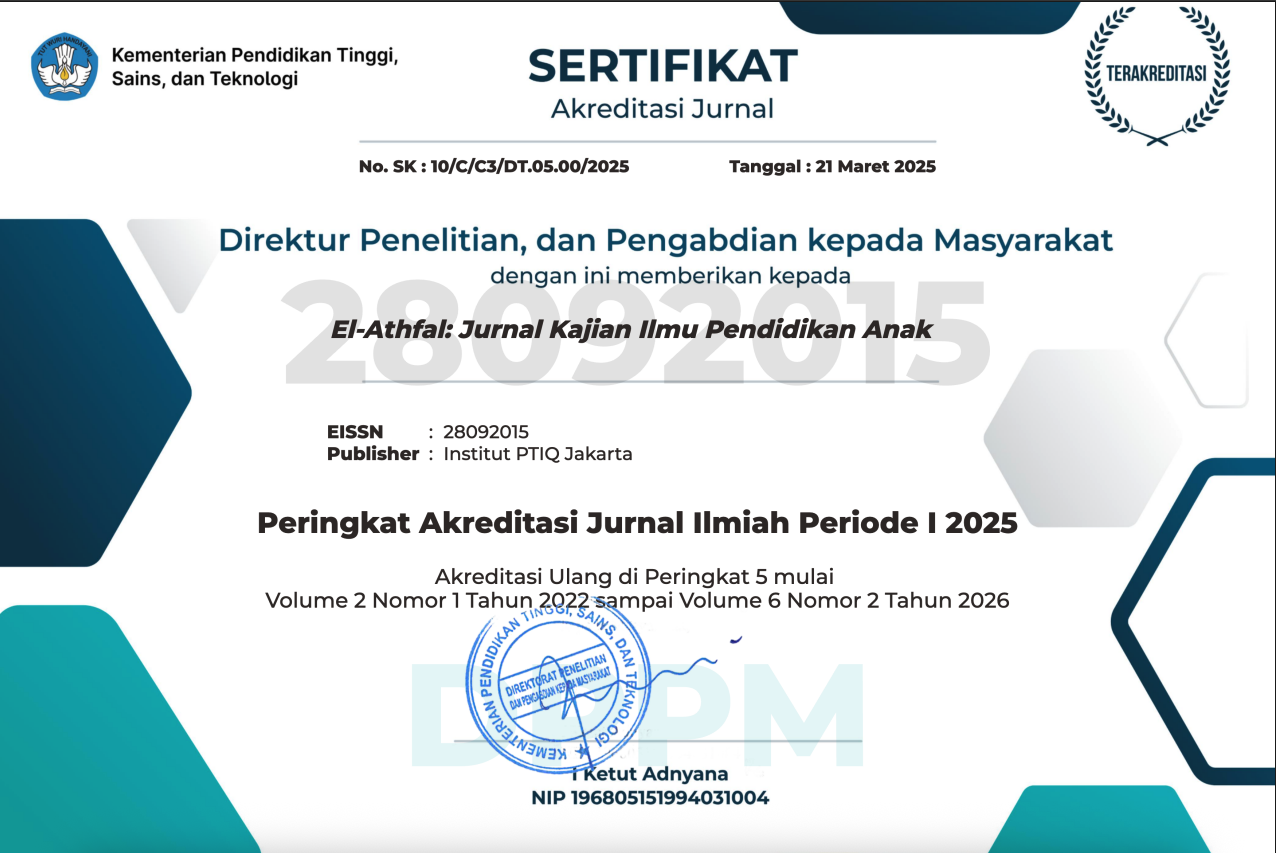
El-Athfal: Jurnal Kajian Ilmu Pendidikan Anak invites researchers, lecturers, teachers, students, education practitioners, and scholars to submit original scholarly manuscripts related to child education and Early Childhood Education, particularly within Islamic and interdisciplinary perspectives.
Authors must ensure that their manuscripts comply with the following requirements:
The manuscript must be original, scientifically sound, and relevant to the journal's focus and scope.
The manuscript must not have been previously published in another journal or be under consideration for publication elsewhere.
The manuscript must be written in clear academic English or Indonesian, subject to the journal's applicable language policy.
The manuscript must follow the journal's prescribed structure, formatting requirements, citation style, and reference guidelines.
All sources, data, ideas, and materials obtained from other works must be appropriately acknowledged and cited.
All listed authors must have made qualifying scholarly contributions, approved the submitted version, and agreed to the submission.
Authors must disclose relevant conflicts of interest, funding sources, and applicable research ethics approvals.
Manuscripts must comply with the journal's plagiarism policy and publication ethics requirements.
The journal accepts manuscripts addressing topics related to child education, including but not limited to:
Islamic Early Childhood Education and the integration of Islamic values in education.
Child development, educational psychology, and learning behavior.
Child guidance and counseling.
Educational technology and digital learning media.
Teaching practices, pedagogical innovations, and best practices.
Learning methods, strategies, and instructional design.
Parenting, family education, and parent–school partnerships.
Educational administration and institutional management.
Curriculum development, implementation, and evaluation.
Character education, moral development, and social-emotional learning.
Inclusive education and children with special educational needs.
Educational assessment and evaluation.
Educational policy and contemporary issues in child education.
Submissions must demonstrate a clear contribution to knowledge, educational theory, research methodology, or professional practice.
The journal considers the following types of scholarly manuscripts:
Original Research Articles: Empirical studies using quantitative, qualitative, or mixed-methods approaches.
Conceptual Articles: Papers presenting new ideas, conceptual frameworks, models, or critical analyses.
Theoretical Articles: Studies that develop, examine, or critically evaluate theories relevant to child education.
Literature Review Articles: Critical syntheses of relevant literature, including systematic and narrative reviews.
Educational Practice and Innovation Articles: Research-based discussions of educational interventions, teaching innovations, and evidence-based practices.
All submissions must demonstrate academic rigor, clarity of argument, and relevance to the journal's readership.
Research articles should generally follow the structure below. Adjustments may be made for conceptual papers, theoretical studies, and literature reviews where appropriate.
The title should be concise, informative, and representative of the manuscript's central topic. It should avoid unnecessary abbreviations and clearly communicate the focus of the study.
The manuscript should include the full names of all authors, their institutional affiliations, and the email address of the corresponding author. The corresponding author must be clearly identified.
For double-anonymous peer review, author identities and affiliations should be provided in the designated submission metadata or a separate title page, while the main manuscript should be anonymized.
The abstract should summarize the purpose, methodology, principal findings, and conclusions of the study.
The abstract should generally contain 150–250 words and be accompanied by 3–5 keywords that represent the main concepts of the article.
For manuscripts written in Indonesian, an English abstract should also be provided if required by the journal's language and publication policy.
Provide three to five keywords that reflect the manuscript's principal themes, concepts, research subjects, or methods. Keywords should be specific and avoid simply repeating every word in the title.
The introduction should explain the research background, relevant scholarly context, research problem, and significance of the study. It should identify the research gap, establish the rationale for the study, and clearly state the research objectives or questions.
Where appropriate, this section should critically discuss relevant previous studies, theories, and conceptual frameworks. Authors should demonstrate how their research relates to existing scholarship and identify the contribution their study seeks to make.
This section may be integrated into the introduction when more appropriate to the manuscript's structure.
For empirical research, the methods section should describe the research design, participants or data sources, sampling procedures where applicable, instruments, data collection procedures, and analytical techniques.
Authors should provide sufficient methodological detail to allow readers to assess the rigor and credibility of the research. Ethical approval and consent procedures should be reported where applicable.
The results section should present the research findings clearly and systematically, using tables, figures, or other appropriate forms of presentation where necessary.
The discussion should interpret the findings in relation to the research questions, relevant theories, previous studies, and implications for child education. Authors should distinguish their findings from interpretations and avoid claims unsupported by the evidence.
For conceptual and review articles, the organization of the main discussion may be adapted to suit the nature of the manuscript.
The conclusion should summarize the principal findings and their implications in relation to the research objectives. It should not merely repeat the abstract or introduce substantial new information.
Recommendations for educational practice, policy, or future research may be included where appropriate.
Authors may acknowledge individuals or institutions that provided meaningful assistance but do not qualify for authorship.
Research funding, institutional support, and relevant grant information must be disclosed. If no external funding was received, authors may state this explicitly.
Authors must disclose any financial, professional, institutional, or personal relationships that could reasonably be perceived as influencing the research or its interpretation.
If no conflicts of interest exist, authors should provide an appropriate declaration.
The reference list must include all sources cited in the manuscript and must not include sources that are not cited in the text.
Authors should prioritize relevant, credible, and up-to-date scholarly sources, including peer-reviewed journal articles and academic books. Every reference must contain sufficient bibliographic information to enable verification.
Authors should prepare their manuscripts according to the journal's official article template, where available. Unless the journal specifies otherwise, the following preliminary formatting recommendations may be used:
Paper size: A4.
Font: Times New Roman, 12-point.
Line spacing: 1.5 for the main text.
Text alignment: Justified.
Margins: 2.5 cm on all sides.
File format: Microsoft Word (.doc or .docx).
Headings: Organized consistently using a clear hierarchy.
Tables and figures: Numbered consecutively and provided with descriptive titles or captions.
Abbreviations: Defined at first use.
Page numbers: Included consistently throughout the manuscript.
These formatting details should be adjusted to match the official journal template if one is provided.
As a preliminary guideline, research articles should generally contain approximately 4,000–8,000 words, excluding references, tables, and figures.
Conceptual articles and literature reviews may vary in length depending on their objectives and analytical depth. Authors should ensure that the manuscript is sufficiently comprehensive without unnecessary repetition.
The editorial team may request adjustments to manuscript length when necessary.
Authors should use a consistent citation and referencing style throughout the manuscript. The journal may adopt the American Psychological Association (APA), 7th edition, as its reference style, subject to confirmation by the editorial team.
Under APA style:
In-text citations should include the author's surname and year of publication.
Direct quotations should include the relevant page number or another appropriate locator.
References should be arranged alphabetically by the surname of the first author.
Digital Object Identifiers (DOIs) should be included as clickable URLs when available.
All in-text citations must correspond to entries in the reference list.
Authors are encouraged to use reference management software, such as Zotero, Mendeley, or EndNote, to maintain consistency and accuracy.
Tables, figures, photographs, diagrams, and other visual materials should contribute directly to the presentation of the research.
Authors must:
Number tables and figures consecutively.
Provide clear titles, captions, labels, and source information where necessary.
Refer to each table or figure in the main text.
Ensure that visual materials are legible and of appropriate quality.
Obtain permission to reproduce copyrighted materials when required.
Protect the identity and privacy of children and other research participants in photographs and visual materials.
Any images or materials involving identifiable children must be handled in accordance with applicable consent, privacy, and research ethics requirements.
Authors must conduct and report research in accordance with accepted standards of academic integrity and research ethics.
For research involving children, parents, teachers, or other human participants, authors should:
Obtain approval from an appropriate research ethics committee when required.
Obtain informed consent from parents or legal guardians where applicable.
Obtain children's assent when appropriate to their age, maturity, and the research context.
Protect participants' identities, confidentiality, and personal information.
Explain relevant ethical safeguards in the manuscript.
Report research procedures and findings accurately and transparently.
Authors must not fabricate or falsify data, manipulate findings dishonestly, or misrepresent research procedures.
All manuscripts submitted to El-Athfal: Jurnal Kajian Ilmu Pendidikan Anak must be original and must appropriately acknowledge the work of other researchers.
The journal may use plagiarism detection software or other appropriate screening methods to assess textual similarity. Similarity reports are evaluated contextually, and the editorial team considers the nature and extent of overlap rather than relying exclusively on a numerical score.
Authors should consult the journal's Plagiarism Policy for further information about screening procedures, similarity thresholds, and possible editorial actions.
Authors who use artificial intelligence (AI) tools in preparing their manuscripts must do so responsibly and transparently, in accordance with the journal's applicable AI policy.
AI tools must not be listed as authors. Human authors remain fully responsible for the accuracy, originality, integrity, and ethical compliance of the submitted work.
Authors should verify all AI-assisted content, including factual statements, citations, references, translations, and analytical claims. AI-generated references must not be included unless their existence and bibliographic accuracy have been independently verified.
Any disclosure of AI use should follow the journal's specific requirements and distinguish permitted language assistance from AI involvement in research design, data analysis, or the generation of substantive scholarly content.
All listed authors must meet the journal's authorship criteria. Authors should agree on the author list and order before submission.
The corresponding author is responsible for communicating with the editorial office, confirming that all authors approve the manuscript, and ensuring that author information is accurate.
Changes to authorship after submission require a justified request and the agreement of all affected authors, subject to editorial approval.
Please refer to the journal's Authorship Criteria page for further details.
Manuscripts must be submitted through the journal's official online submission system.
Authors should:
Register or log in to the journal's submission platform.
Complete all required submission metadata accurately.
Upload the manuscript in the required file format.
Provide the title, abstract, keywords, author details, and references as requested.
Upload supplementary documents, ethical approval statements, or other required files where applicable.
Confirm that the manuscript complies with the journal's originality, authorship, and publication ethics requirements.
Complete the submission process and monitor communications from the editorial office.
Authors should ensure that the manuscript file is appropriately anonymized if the journal uses double-anonymous peer review.
Submitted manuscripts undergo an initial editorial screening to assess their relevance to the journal's focus and scope, originality, completeness, methodological quality, and compliance with the author guidelines.
Manuscripts that pass the initial screening may be sent to qualified reviewers for peer review. Editorial decisions may include acceptance, minor revision, major revision, or rejection.
Authors asked to revise their manuscripts should respond to reviewers' comments carefully and provide a clear explanation of the changes made. Submission of a revised manuscript does not guarantee acceptance.
The final publication decision rests with the journal's editorial team.
El-Athfal: Jurnal Kajian Ilmu Pendidikan Anak does not charge a submission fee.
An Article Processing Charge (APC) of IDR 250,000 per accepted manuscript applies after the manuscript has completed the review and editorial process and has been formally accepted for publication.
Payment of the APC does not influence the editorial decision or guarantee acceptance. Further information is available on the journal's Author Fees page.
Authors should review the journal's copyright and licensing policies before submitting their manuscripts.
If the journal adopts the Creative Commons Attribution 4.0 International License (CC BY 4.0), published articles may be shared and adapted in accordance with that license, provided that appropriate attribution is given.
The applicable copyright arrangements and license terms must be confirmed in the journal's official Licence policy.
Before submitting a manuscript, authors should confirm that:
The manuscript falls within the journal's focus and scope.
The work is original and is not under consideration by another journal.
The manuscript follows the required structure and formatting guidelines.
The abstract and keywords are provided as required.
All sources are cited accurately and included in the reference list.
Tables, figures, and other visual materials are appropriately labeled and credited.
Authorship, funding, conflicts of interest, and ethical requirements are addressed.
The manuscript complies with the journal's plagiarism and AI policies.
The submission metadata and author information are complete and accurate.
The manuscript file meets the journal's peer-review requirements.
By submitting a manuscript to El-Athfal: Jurnal Kajian Ilmu Pendidikan Anak, authors acknowledge that they have read and agreed to comply with the journal's author guidelines, editorial procedures, and publication ethics policies.
| JOURNAL IDENITITY |
| ISSN (Print): 2338-4131 |
| ISSN (Online): 2715-4793 |
| DOI: doi.org/10.56872/elathfal |
| DOWNLOAD FOR AUTHOR |

